
Peshtemal vs Terry Towel: What Is the Difference?
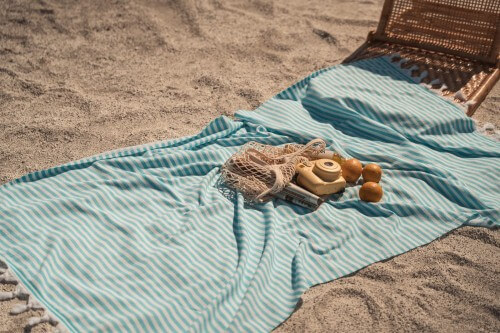
A peshtemal and a terry towel can serve many of the same purposes, but they are made with different fabric constructions and feel very different in use.
The main difference is simple: a peshtemal is flat-woven, while a terry towel uses a looped pile. That difference affects weight, bulk, water absorption, drying time and the way each product fits into a retail or hospitality collection.
What is a peshtemal?
A peshtemal, also known as a Turkish towel or hammam towel, is a flat-woven textile traditionally associated with Turkish baths.
Because there is no raised terry pile, peshtemals are generally lighter and less bulky than conventional bath towels. They fold into a small space and are commonly used for the beach, pool, spa, hammam, travel and everyday bathing.
Peshtemal House offers more than 60 peshtemal designs in different woven constructions, including stripes, jacquard, waffle and stone-washed styles. Most designs are cotton, while selected products use cotton-bamboo or cotton-linen blends.
What is a terry towel?
A terry towel is woven with loops that rise from the surface of the fabric. These loops create a larger surface area for absorbing water and give the towel its familiar soft, fuller feel.
Terry construction is therefore widely used for bath towels, spa towels and other products where a thicker hand feel and higher water-holding capacity are preferred.
Some designs also combine the two concepts. One-side terry peshtemals have terry loops on one face and a flatter woven surface on the other.
Peshtemal vs terry towel
| Feature | Peshtemal | Terry towel |
|---|---|---|
| Construction | Flat-woven | Looped pile |
| Weight | Generally lighter | Generally heavier |
| Bulk | Packs compactly | Takes more storage space |
| Water handling | Absorbent, with less fabric bulk | Looped pile holds more water |
| Drying | Generally faster | Generally slower due to thicker pile |
| Typical uses | Beach, pool, hammam, travel, spa, bath | Bath, spa, home and hospitality |
| Appearance | Strong woven-pattern focus | Fuller towel appearance |
Neither construction is automatically better. The right choice depends on how the product will be used and the type of collection being developed.
Which towel is better for a beach collection?
Peshtemals are particularly practical for beach and travel ranges because they are light and compact.
Their woven surface also provides many options for stripes, geometric patterns and jacquard designs. This makes the product useful when visual design is an important part of the collection.
For customers who want a thicker towel while keeping some peshtemal characteristics, one-side terry constructions can provide a middle ground.
Which is better for bath and spa use?
For buyers looking for the familiar thickness and water-holding capacity of a conventional bath towel, terry is usually the more natural choice.
Peshtemals can still work well in hammams, spas and bathrooms, particularly when lower bulk, woven design and faster drying are priorities.
Many collections therefore use both rather than choosing only one.
Can peshtemals and terry towels carry a private label?
Yes.
Peshtemal House products can be supplied under the buyer's own brand. Orders start at 100 pieces in total and can be mixed across products and designs.
Peshtemals are kept in stock. Terry towel availability varies by design, so current stock should be confirmed before ordering.
For completely new constructions, custom jacquard designs or OEM programmes, production projects are handled directly by PH Tekstil, the manufacturer behind Peshtemal House.
Where are they produced?
Peshtemal House is PH Tekstil's own brand and collection.
PH Tekstil operates its own weaving production in Denizli, Turkey, with 30 jacquard and dobby looms: 20 jacquard and 10 dobby. Its weaving capabilities include both peshtemal and terry fabrics.
For buyers developing an original product rather than choosing from the ready-stock collection, PH Tekstil also offers custom jacquard, private-label and OEM production.
Which one should you choose?
Choose a peshtemal when light weight, compact packing and woven design are important.
Choose a terry towel when a fuller towel construction and greater water-holding capacity are the priority.
For many brands, the strongest range includes both: peshtemals for beach, travel and design-led uses, and terry towels for more traditional bath and spa applications.

Jacquard vs Dobby Weaving: What Is the Difference for Peshtemals?
How to Order Peshtemals Wholesale: A Guide for Buyers
Peshtemal vs Terry Towel: What Is the Difference?
What is Peshtemal? The Place of Peshtemal from the Past to the Future

Types of Peshtemal Fabrics: Cotton, Bamboo, Linen and Recycled Cotton

History of Peshtemal: From the Ottoman Empire to Today

Different Usage Areas of Peshtemal

