Jacquard vs Dobby Weaving: What Is the Difference for Peshtemals?

Jacquard and dobby are two ways of weaving a pattern into a peshtemal. In both cases the design is part of the fabric itself; it is not printed or embroidered on the surface.
The difference lies in how the loom controls the warp threads. That affects the scale, complexity and type of pattern that can be woven.
What is dobby weaving?
On a dobby loom, the warp threads are lifted in groups. Each group runs through a shaft, also called a harness frame, and the dobby mechanism decides which shafts rise for every pass of the weft.
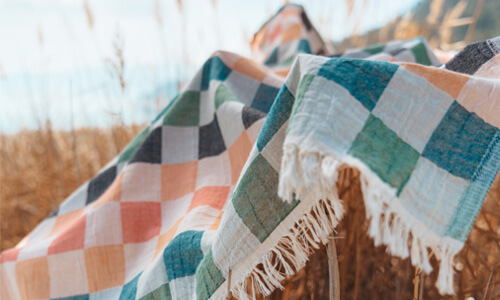
Because the loom works with a limited number of shafts, dobby weaving suits patterns built from small, repeating units: checks, geometric motifs, diamonds and textured structures such as waffle and honeycomb. In Turkish, dobby weaving is known as armür.
What is jacquard weaving?
On a jacquard loom, each warp thread can be lifted individually. The pattern is therefore not limited to a small repeat.
This makes it possible to weave large motifs, curved and figurative designs, logos, lettering and even photographs or portraits directly into the fabric.
The technique takes its name from Joseph Marie Jacquard, who introduced the punched-card jacquard mechanism in the early 19th century. Today, jacquard designs are prepared digitally and sent to an electronic jacquard system on the loom.
Jacquard vs dobby at a glance
| Feature | Dobby | Jacquard |
|---|---|---|
| How the warp is lifted | In groups, through shafts | Each warp thread individually |
| Pattern type | Checks, small geometric repeats, textures | Large motifs, curves, logos, lettering, images |
| Pattern size | Small, repeating units | Large repeats or a single placed design |
| Design preparation | Simpler | More detailed design work |
| Typical peshtemal styles | Checked, diamond, waffle and honeycomb | Ornamental, figurative and branded designs |
| Custom logo | Generally not suited to detailed logos | Suitable, including detailed artwork |
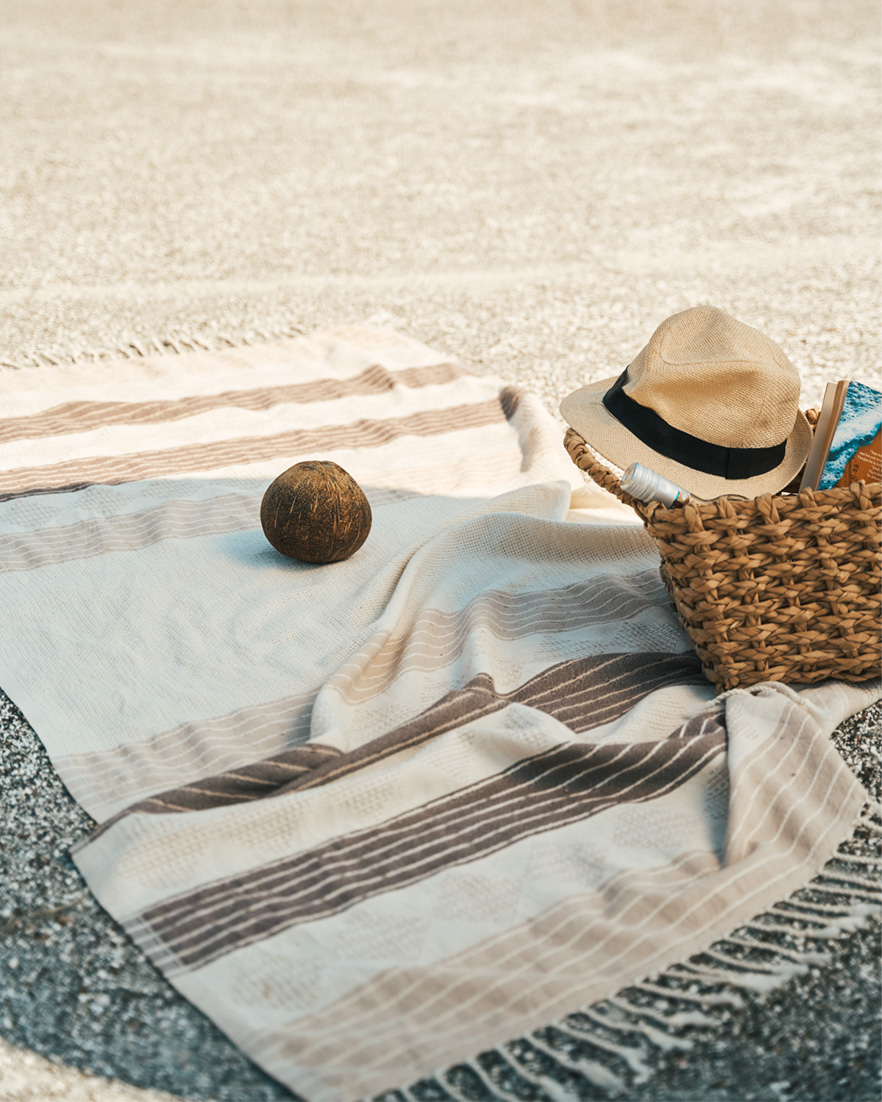
Stripes are a special case. They come mainly from the arrangement of coloured warp and weft yarns, so striped peshtemals can be woven on either type of loom.
Is jacquard better than dobby?
Not automatically. Jacquard offers more design freedom, but a well-made dobby peshtemal is not a lower-quality product.
The hand feel, weight, absorbency and durability of a peshtemal depend mainly on the yarn, the weave construction, the fabric weight and the finishing. The type of loom mostly decides which pattern can be woven.
Many collections combine both: dobby designs for classic checks and textures, and jacquard designs for statement patterns and branded products.
Which one should you choose?
Choose dobby when you want clean geometric patterns, textured surfaces such as waffle or honeycomb, or a classic hammam look.
Choose jacquard when the pattern cannot be broken into small repeats, or when you want your logo, artwork or a placed motif woven into the fabric.
Can a logo be woven into a peshtemal?
Yes, on a jacquard loom. Logos, lettering and detailed artwork are woven into the fabric rather than printed on the surface. Because the design is formed by the yarns, there is no surface-printed design layer to peel away. A dobby loom is better suited to smaller, repeating geometric motifs and is generally not the right choice for detailed logos or pictorial artwork.
Ready-stock designs or a custom jacquard?
Peshtemal House keeps peshtemals in stock in different woven constructions. Orders start at 100 pieces in total, mixable across all products, and can be supplied under your own brand.
For an original design, PH Tekstil, the manufacturer behind Peshtemal House, offers custom jacquard production. Customers send a logo, drawing, image or idea, and PH Tekstil's designers turn it into a jacquard design. After the design is approved, a sample can be prepared the next day; samples are charged. The minimum order for a custom design depends on the number of colours, the weave construction and the production requirements.
PH Tekstil's jacquard and dobby looms
PH Tekstil operates its own weaving production in Denizli, Turkey, with 30 jacquard and dobby looms: 20 jacquard and 10 dobby. The jacquard looms, 8 Picanol and 12 Dornier, work with Stäubli jacquard systems. Patterns are prepared by two in-house designers in NedGraphics design software.
Jacquard vs Dobby Weaving: What Is the Difference for Peshtemals?
How to Order Peshtemals Wholesale: A Guide for Buyers
Peshtemal vs Terry Towel: What Is the Difference?
What is Peshtemal? The Place of Peshtemal from the Past to the Future
Types of Peshtemal Fabrics: Cotton, Bamboo, Linen and Recycled Cotton
History of Peshtemal: From the Ottoman Empire to Today
Different Usage Areas of Peshtemal